Olympic Rings
Five rings, one world — the emblem that binds every nation to a single flame.

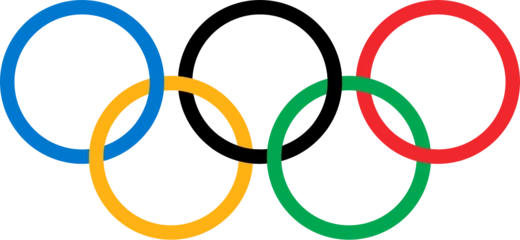
The Olympic Rings — five interlocking circles in blue, yellow, black, green, and red set against a white field — are the most instantly recognizable emblem of the modern Olympic movement. Designed by Baron Pierre de Coubertin in 1913, the symbol was conceived as a visual shorthand for the unity of the world's inhabited continents through the shared language of sport. Since its first appearance at the 1920 Antwerp Games, the rings have flown above every Summer and Winter Olympic stadium, anchoring the ceremonies, the flag, and the entire visual identity of the Games.
In the broader ceremonial architecture of the Olympics, the rings serve as the visual 'seal' of the event. They appear on the Olympic flag raised during the opening ceremony, on the stadium's central display, on athlete credentials, and in the presentation of the Olympic flame. For a spectator, the moment the rings descend into the stadium bowl is often the single most charged image of the Games — a reminder that, for a fortnight, the world is one.
- Designer
- Baron Pierre de Coubertin
- Year designed
- 1913
- First flown at
- 1920 Antwerp Games
- Ring colors
- Blue, Yellow, Black, Green, Red
- Flag background
- White
- Symbolism
- Unity of the five inhabited continents through sport
- Status
- Permanent symbol of the Olympic Movement
Lore & Background
When Coubertin sketched the interlocking rings in 1913, the modern Olympics were still a young experiment, barely a decade into their second decade of life. He needed a mark that could travel on a flag, a badge, a printing press, and a stadium screen without losing its meaning. The five circles, arranged three above two and interlocked rather than merely overlapping, spoke of connection that could not be pulled apart. The palette of blue, yellow, black, green, and red on white was, by Coubertin's own account, chosen because every national flag in existence at the time contained at least one of those hues — a deliberate nod to universality rather than to any single nation's colors.
The rings debuted publicly at the 1920 Antwerp Games, where the flag bearing them was raised for the first time in a stadium. From that moment the emblem became inseparable from the ritual: the flag is unfurled in the opening ceremony, the rings are displayed on the stadium's main screen during the parade of nations, and the same five circles appear on the medals, the torch relay banners, and the closing-ceremony handover. No host city redesigns them; no sponsor alters their spacing. They are, in effect, the only fixed visual in an event that otherwise reinvents its look every four years.
Over a century of Games has layered additional meaning onto the rings. They have flown above stadiums in wars, in peace, in boycotts, in reunifications. Athletes from every confederation have stood beneath them while their national anthem played, and the rings have watched without favor. That neutrality — the refusal to privilege any single flag, language, or creed — is the quiet promise the emblem makes each time it descends into the bowl.
In Their Own Story
The stadium is empty except for the sound. A low, resonant hum from the crowd of eighty thousand, a sound like the sea heard from a great distance. Then the lights dim to a deep amber, and a single spotlight finds the center of the track. A silk panel, impossibly large, begins to unfurl from a hidden gantry. The white field catches the light first, and then the rings resolve out of the shadow — blue, black, red across the top; yellow, green below — interlocked, patient, ancient in their geometry. The crowd inhales as one. Somewhere in the stands, a grandmother in a faded 1992 jacket presses her palms together. The rings hang there, suspended, for a long beat that feels like a held breath. Then the music swells, the flag rises, and the Games begin.
Reader's Guide
The Olympic Rings are not merely a logo; they are a ceremonial object with a fixed sequence of appearances that every host city must honor.
The first and most sacred moment is the raising of the Olympic flag during the opening ceremony. A single bearer — or in some editions, a small group of children — carries the flag to the center of the stadium, where it is unfurled and raised to the national anthem or the Olympic Hymn. The rings, now visible to the full audience and the global broadcast, mark the official opening of the Games.
Throughout the fortnight, the rings appear on the stadium's central display during each day's medal presentations, on the torch relay banners, and on the credentials of every accredited person. In the closing ceremony, the flag is lowered, folded, and handed to the mayor of the next host city — a physical passing of the rings' authority.
Host cities are free to design their own emblems, mascots, and visual identities, but the rings themselves are never altered, recolored, or repositioned. Their spacing, interlocking, and color order are fixed by the Olympic Charter. This rigidity is the point: in a spectacle that otherwise celebrates local color and creativity, the rings are the one constant, the one image that says the same thing in every language — that the world, for these few days, is a single community bound by the act of competition.
Did You Know?
- Coubertin chose the five ring colors — blue, yellow, black, green, and red — on a white background because, at the time, every national flag in the world contained at least one of those colors.
- The rings are interlocked, not merely overlapping: each circle passes through its neighbors in a fixed over-under pattern, symbolizing that the continents are bound together and cannot be separated.
- The Olympic flag bearing the rings is, by rule, never lowered to half-mast, even in observance of a death or a tragedy.
- The rings first appeared publicly at the 1920 Antwerp Games, making them a full decade younger than the 1913 sketch that first gave them form.
More in Ceremonies & Traditions
Elsewhere in the The Olympics universe
Spotted an error? Know more?
This is a living reference — every entry is fact-audited, and reader corrections feed straight into our audit queue. Suggest an edit · See this site's audit record